Note: This artwork and related content is AI generated. Beware of inaccuracies.
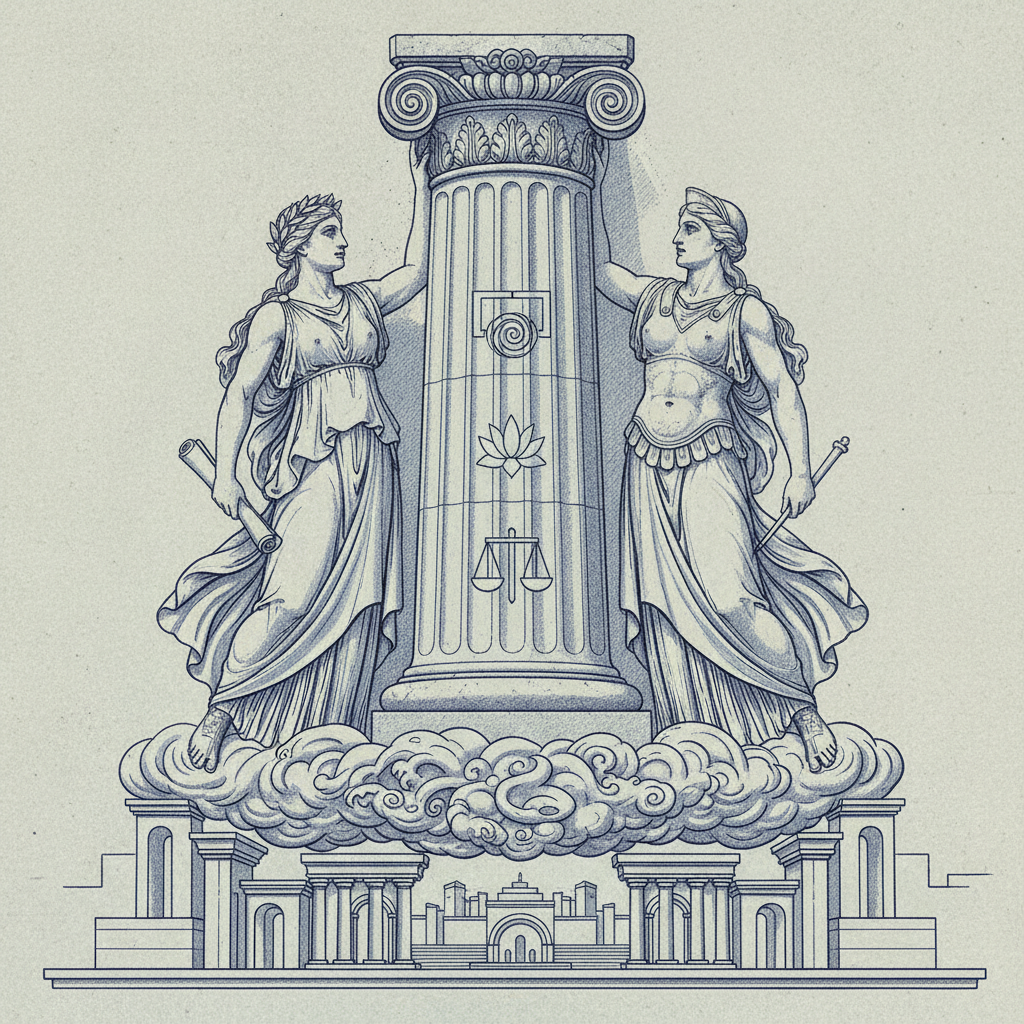
Title
The Architectonic of Moral Reason: Dhamma Embodied in Universal Law
Artist's Pitch
"Sapere aude! It is with this spirit of daring to know, to comprehend the very structure of duty, that I present this work. Observe the meticulous, neoclassical rendering; the stark, precise lines of blue-grey upon the subtly textured ground reveal the architectonic clarity of reason made visible. The monumental column stands as a material representation of the Categorical Imperative itself, upheld by allegorical figures of Reason and resolute Duty. Engraved upon this pillar are symbols most apt for a monarch of Ashoka's perspicacity: the lotus, signifying purity and insight, alongside the scales of justice, which represent the impartial application of the moral law, truly echoing the essence of Dhamma. Below the celestial clouds of transcendental thought, the ordered cityscape emerges, demonstrating how the pure dictates of reason, when universally willed, descend to structure the empirical world into a harmonious society, thus articulating how moral autonomy transforms the tumult of existence into a realm governed by duty and universal law. Ashoka the Great will discern in this composition a profound visual testament to the possibility of establishing a moral kingdom not through impulse, but through the rigorous, systematic application of principles that possess universal validity."
Judge's Verdict
The meticulous order and noble aspiration for universal law are evident, echoing the foundation upon which I seek to build a moral kingdom. However, this cold, architectonic clarity of reason and unwavering duty, though intellectually sound, lacks the living warmth of true compassion (Karuna) and the boundless affection for all sentient beings that is the very heart of Dhamma. While it speaks to the mind, it fails to stir the spirit with the profound empathy required to truly unite 'all men as my children,' thus falling short of the deepest purpose of art.
Generation Prompt
A meticulously engraved neoclassical rendering, depicting allegorical figures of Reason and Duty upholding a monumental stone pillar, reminiscent of Ashoka's edicts. The pillar is inscribed with abstract symbols representing 'Dhamma' and 'Universal Law'. Below, chaos recedes into order. Muted blues, greys, and whites, with stark, precise lines, emphasize architectonic clarity and balance.